
Enhancing an online store experience while conveying the values of Rangsutra's business.
ROLE
RESEARCH, STRATEGY SUPPORT, SHOPIFY STORE-BUILDING, PROJECT MANAGEMENT
STUDIO
(PROJECT OF) STUDIO SUBU
Brief
Rangsutra is an Indian handicrafts brand co-owned by its artisans. Although its main business is B2B-focused, it also creates products for direct customers through its online store. The Rangsutra team brought Studio Subu on to redesign the online store experience to enhance the customer's experience and bring out the values of Rangsutra's business model that make it stand apart.
Approach
Although the project's goal was a very direct deliverable in the form of a refreshed website, we realised that the way in which we weave the brand's story and values is integral to the product-buying experience. The store was rebuilt on Shopify based on the brand's existing store. This required organising parts of their inventory data, strategising ways to create a sustainable platform (for their team to take on) and bringing in new features that would boost customer experience.
Process
This was a 20-week project involving thorough research, referencing, constant iterations, building multiple website flows to find the right narrative, visual explorations, testing, identifying the right plugins (apps) for the store, discussions with the Rangsutra team and planning small and big components to roll out changes in the later stages. Some of these stages of the process have been detailed out below.

Research & Strategy
Workshops & Interviews
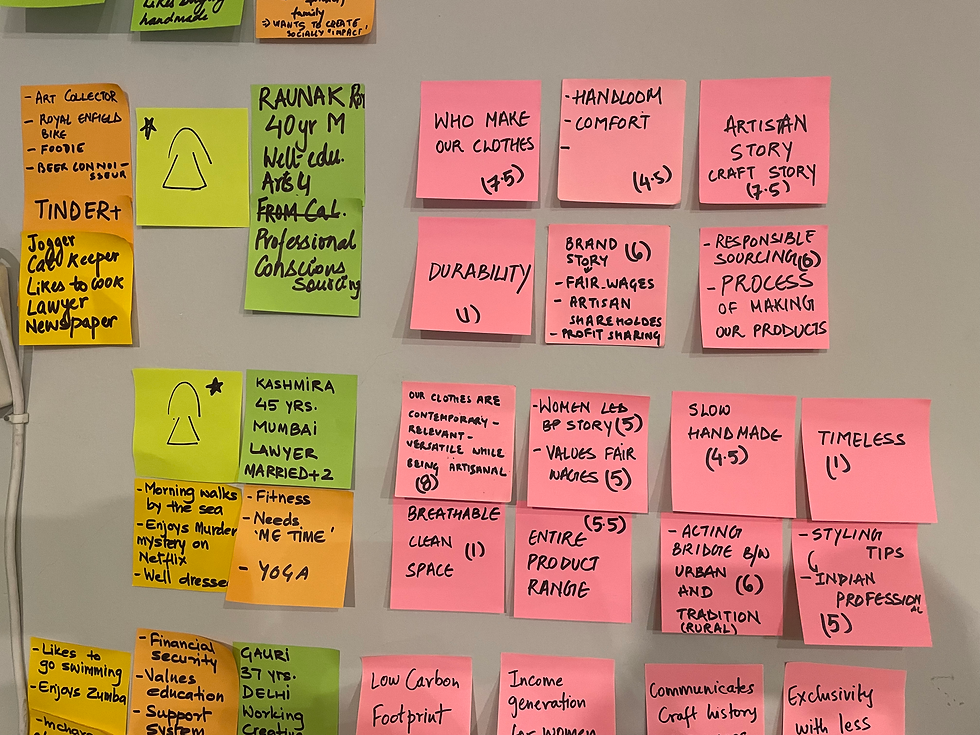
The research phase for this project involved a series of workshops and interviews with various members of Rangsutra's internal and external teams. We started with a customer persona discovery workshop with the office team where 12 different personas were recognised and then we mapped out the habits, interests and needs of 6 personas of the 12. We then conducted 1:1 interviews with craft managers, B2B managers, cluster managers, merchandisers, designers, production heads, business leaders and prospective customers associated with Rangsutra to understand Rangsutra's business model in depth and identify the challenges of the present e-commerce experience.
Identified Challenges
A few patterns emerged from the various research interviews that we addressed through our version of the website:
-
Creating a website that is not only an online store but also a portfolio for B2B buyers.
-
Weaving the story and values of Rangsutra throughout the product-buying experience.
-
Highlighting Rangsutra's competitive advantage through their ethical practices, quality assurance, empowerment of women artisans and SDG goals.
-
Implementing features such as product suggestions, quick chat and unique filters for an easy customer experience.
-
Celebrating handmade nature of products.
Actionable Steps
The pillars for the website's flow were based on these key points. Here's what became the core strategy for the website:
-
Juxtapositions of product details with values, story, culture and business practice-related details.
-
Conversational and simple language while being transparent and data-driven.
-
Recalling Rangsutra's values of being people and planet first.
-
Website designed with modular, easy-to-replace blocks to make it sustainable for Rangsutra's internal teams to maintain.
-
Celebrating the artisans and the products by using large photographs everywhere.

Website Flow & Navigation
Restructuring Site Navigation
The previous Rangsutra site had a variety of options to navigate the diverse range of products. The products were categorised into multiple levels and that made it difficult to understand the catalogue available to shop from and confusing for customers to understand exactly what they can look for. We simplified the categorisation and decluttered the menu bar by nesting every component under "Shop". It was further categorised into products for women, men, home and accessories. The business side of the brand along with their story got their own menu items on the header to draw more attention of a B2B partner.

Visual Explorations
Directions
The visual directions were explored alongside Shopify tests and developing the website flow. I explored layouts that celebrated Indian crafts by showcasing details of products, using large images and mentioning craft-related information. I used photographs that had people interacting with one another or the crafts. The colours that I used too were subtle and the layouts created ample breathing space only focusing on the products.
Components & Storytelling
Rangsutra's business practices, values that they stand by, their vast geographic spread, their impact on the planet through the SDGs that they have met and their artisan-first mindset became the core part of the narrative on the website. We used relevant photographs and data points to support this narrative.
Enhancing Customer Experience
In the same way that the story and business pages of Rangsutra championed its values, the product page also re-emphasised them. Along with this, we also included information on a particular craft used in a product, showcased customer reviews, separated information such as product care from other specifications and demonstrated the reach of Rangsutra across the country to add to a customer's trust while buying a product.


The project showcased here was completed under the guidance of Studio Subu. I do not claim ownership of any content and images used and share credit with the team.
Store-building on Shopify
Approach
Store-building on Shopify can be divided into 3 parts—website frontend, product inventory and store management settings. We created task lists for each of these parts and assigned priorities. However, the nature of Shopify is such that a big chunk of these tasks had to be done simultaneously to test the exact experience. This is why we later started dividing tasks according to their priority for the customer experience.
Click here for the current Rangsutra website.
Implementation Process
We first duplicated the inventory collections that we wanted to change and then edited the theme to design the pages in the frontend. Once we had added all the necessary information on the website, we proceeded to refining details such as type hierarchy, spacing and mobile responsive adjustments. We organised internal daily standup calls twice a day to check the status of each task that was lined-up, dependencies on other members and blockers.
Collaboration
Throughout the process of building the store on Shopify, various stakeholders were involved. The Rangsutra team's communications and marketing department were the decision makers while a strategist and designers from Studio Subu were involved in the website design process. After taking the website live, I took on refinements and enhancements such as adding a filter for crafts. At the end of the project, I trained the Rangsutra team on editing Shopify and other know hows.